For more information, see the Small Station Page at IKI in Russia
Main Scientific Objectives
Studies of the vertical structure of the atmosphere; the
atmosphere and climate of Mars, the internal structure of Mars, the
elemental surface composition, magnetic field, and seismic condition;
TV imaging.
Scientific Payload
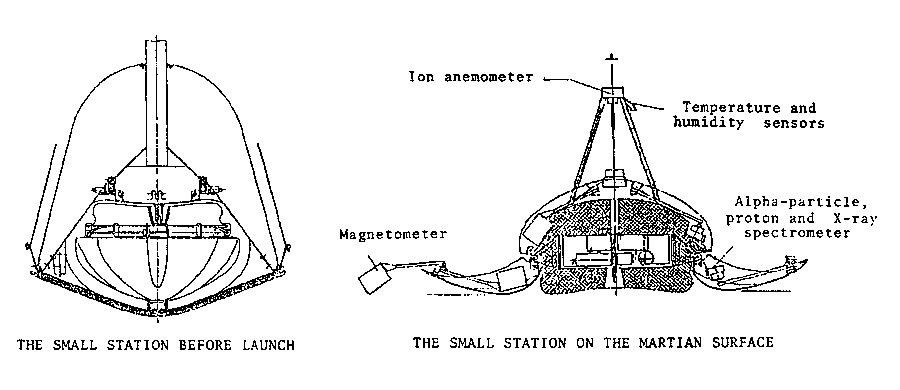
The Small Stations payload includes:
- MIS - Meteorology
Instrument System, including temperature sensors, an absolute
pressure sensor, a relative humidity sensor, an optical.depth sensor
and an ion anemometer
- DPI - Descent Phase
Instrument System including an accelerometer, absolute pressure
and temperature sensors
- APX - Alpha-particle,
Proton and X-ray Spectrometer
- OPTIMIZM -
Seismometer, Magnetometer, and Inclinometer
- PanCam - Panoramic
Camera
- DesCam - Descent Camera
The Small Station housekeeping system includes:
The Station Data Processing Unit (SDPU), which control station operations and data acquisition proceduresA telecommunication unit with a transmitter and a receiver for receiving commands and transmitting data
A power-supply unit which comprises two radio-isotope thermogenerators, a battery, electronics for controlling battery charge, and a secondary power source.


Drawings of Cruise and Landed Configuration of Small StationsMain Characteristics
	Diameter of aerobraking screen		100 cm
	Total mass				33.5 kg
	Payload mass				8 kg
	Mass of instruments			4.6 kg
	Active lifetime on the surface		700 days
	Data transmission rate			2 kbit/s; 8 kbit/s
Entry and Landing
The Mars 96 spacecraft carries two small stations. Five days prior to arrival, the two small stations will be separated from the Orbiter, and the Orbiter will perform a deflection maneuver of about 35 m/s to place it on a trajectory to enter Mars orbit. The two stations will approach Mars independently. Their atmospheric entry velocity will be < 5.75 km/s, their entry angles between 10.5 and 20.5 degree, and their entry azimuth between 115 and 145 degrees. Their landing site dispersion ellipses are ± 10° (600 km) along track and ± 2° (120 km) cross-track. All candidate landing sites are situated on the day-side of Mars, in Arcadia Planitia.
to Mars 96 Index
to Mars 96 Science Objectives
to Mars 96 Mission Description
to Mars 96 Orbiter
to Mars 96 Orbiter Surface and Atmosphere Payload
to Mars 96 Orbiter Space Physics/Plasma Payload
to Mars 96 Orbiter Astrophysics/Cruise Payload
to Mars 96 Small Stations
to Mars 96 Small Station Payload
to Mars 96 Penetrators
to Mars 96 Penetrator Payload
Return to Mars Page
Return to MSSS Home Page