
For more information, see the Mission Page at IKI in Russia
Mars '96 is a Russian mission to Mars scheduled to be launched in November/December 1996. The spacecraft (S/C) consists of an orbiter and four landers (two small, moderately soft landers and two penetrators). Only a single S/C will be launched during this opportunity. The mission consists of seven phases: launch and injection towards Mars, cruise (including 2 midcourse corrections), small station release and orbiter deflection maneuver, orbit insertion, orbit corrections, penetrator release, and mapping operations.
1. Launch and Trans-Mars Injection
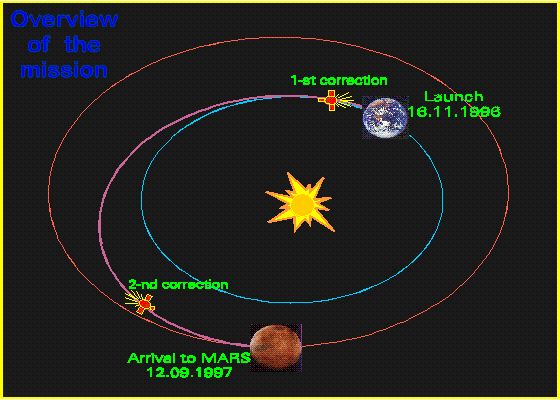
Figure from IKI Mars '96 Mission Page
2. Cruise
3. Small Station Release and Orbiter Deflection Maneuver
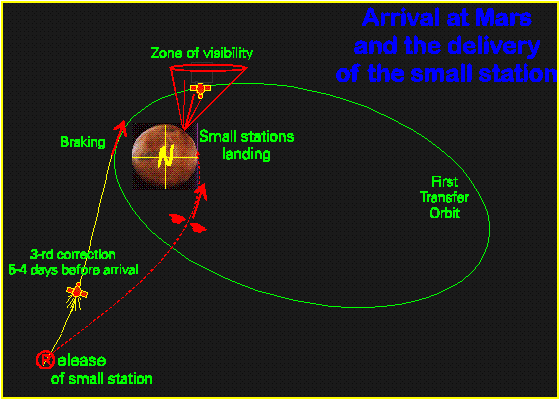
Figure from IKI Mars '96 Mission Page
4. Mars Orbit Insertion
5. Orbit Corrections
6. Penetrator Release
For deployment, the Orbiter will first be properly oriented. The penetrator to be released will be spun about its longitudinal axis for stability and ejected. The penetrator's solid rocket motor will be ignited after moving a safe distance away from the Orbiter; the burn will place the penetrator into a atmospheric entry trajectory. Entry occurs 21-22 hours later. It is possible to deploy both penetrators on a single orbit. In the martian atmosphere, the probes undergo aerodynamic braking, first using a rigid cone and then an air-inflated braking device, until a given velocity is reached to provide their penetration into martian regolith. The entry velocity is 4.9 km/s at an entry angle of 12± 2°. The landing site error ellipse is ± 4° (240 km) along-track and ± 0.5° (30 km) cross-track. The penetrator impacts the surface at a velocity of 80 ± 20 m/s and the forebody separates from the aftbody. The penetrating part of the probe forebody, carrying the scientific and housekeeping instrumentation, enters the regolith down to 5-6 m, while the aftbody, with the rest of the instrumentation, remains on the surface. Scientific studies begin after penetration. Data are relayed to Earth by the Orbiter.
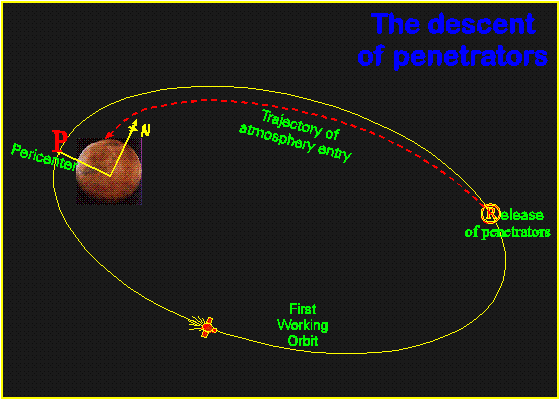
Figure from IKI Mars '96 Mission Page
7. Orbital Operations
Once the penetrators have landed, the S/C propulsion module will be jettisoned and the ARGUS science platform deployed. After 50-60 days, the orbit periapsis will precess into the illuminated portion of Mars, and the Orbiter's surface and atmosphere instruments will be used extensively. The best illumination conditions will be encountered about 90 days in orbit. At this time, the orbital period will be adjusted to permit a 1° shift of ground tracks every 4 days. After this adjustment, the Orbiter will not be able to view the landers for data relay. Six additional orbit corrections are budgeted for orbit sustenance (Delta-V < 45 m/sec).
8. Other Relevant Mission Information
Tracking from the Evapatoria and Ussurijsk facilities varies from a maximum of around 8 hrs (angle > 7° ) to about 6.5 hr two months after MOI. Joint visibility decreases from 1.5 hr to 0.1 hr during this time.
Solar conjunction occurs in May 1998:
	Sun-Mars-Earth angle	 Dates

		< 2		1-26 May
		< 1		8-20 May
		<0.1		13-14 May
After the Orbiter completes its primary mission, aerobraking will be used to attempt to lower the orbital period from 43 to 8-10 hours.