
XGRS, designed and built by The Johns Hopkins University Applied Physics Laboratory, consists of two state-of-the-art sensors: an X-ray fluorescence spectrometer and a gamma-ray spectrometer.
Spectroscopy
Redundant solar monitors are used to determine the incident solar X-ray spectrum. X-rays from the Sun can produce significant count rates of fluorescence X-rays from low-atomic-number surface elements on Eros, such as Mg, Al, and Si. The elements S, Ca, Ti, and Fe are also present in asteroids, but count rates are lower and data take longer to accumulate.Similarly, cosmic ray protons (and energetic particles associated with solar flares) can interact with the asteroid surface and produce gamma rays characteristic of the nuclear energy levels of a given element. Gamma rays can also be spontaneously emitted by naturally occurring radioactive elements such as K, U, and Th.
Remote X-ray and gamma-ray spectroscopy from spacecraft requires bodies with little atmosphere so that the X-rays and gamma rays returning to the spacecraft are not significantly absorbed. Orbital rather than flyby missions are preferred for this type of measurement because of the long observation time required.
Specifications
XGRS General
Power: 24 W (including DPU)
Development time: 19 months
X-Ray Fluorescence Spectrometer
Energy range: 1 to 10 keV; Rise-time discrimination to reduce background contamination
Energy resolution: <1 keV FWHM @ 5.95 keV In-flight calibration sources: 55Fe
Counting rate: Full performance up to 10 kHz
X-Ray Solar Monitors
Gamma-Ray Spectrometer
Prime detector: 2.5 x 7.5 cm NaI (Tl) scintillator; 8.5% FWHM min resolution @ 662 keV FOV ~ 60°
Shield detector: 8.9 x 14 cm BGO scintillator cup shield; 15% FWHM min resolution @ 662 keV
Counting rate: Full performance up to 10 kHz
XGRS Instruments:
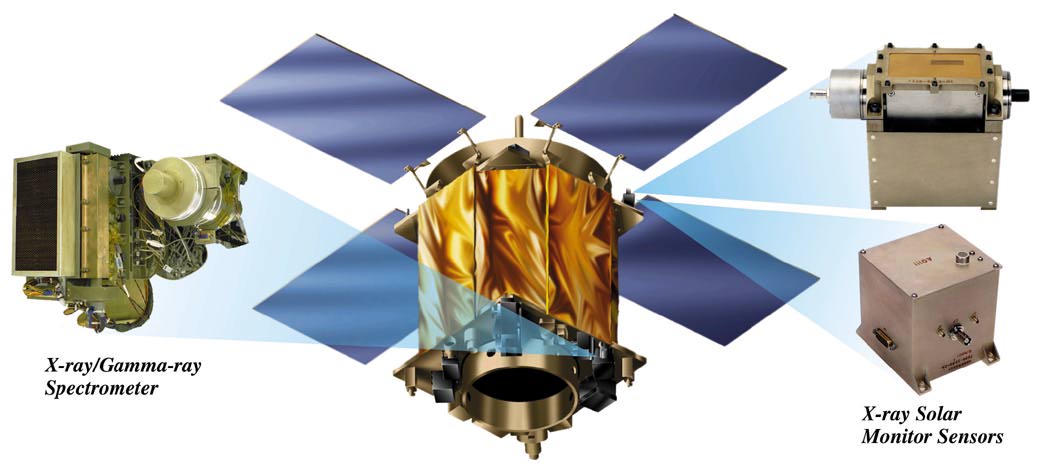
XGRS on spacecraft
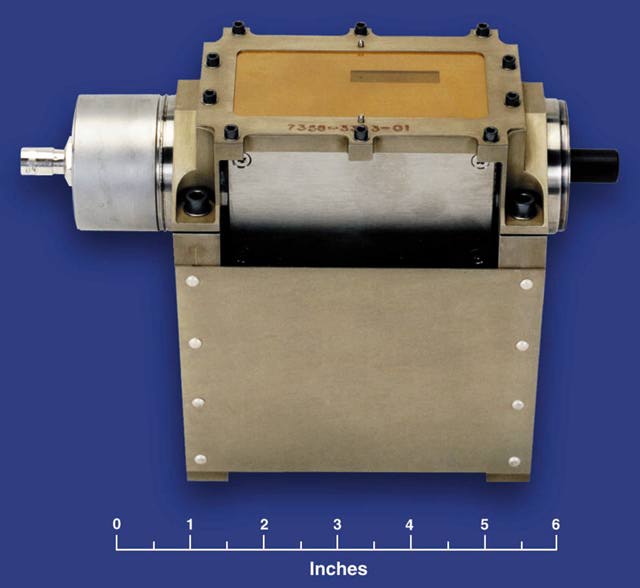
Proportional counter
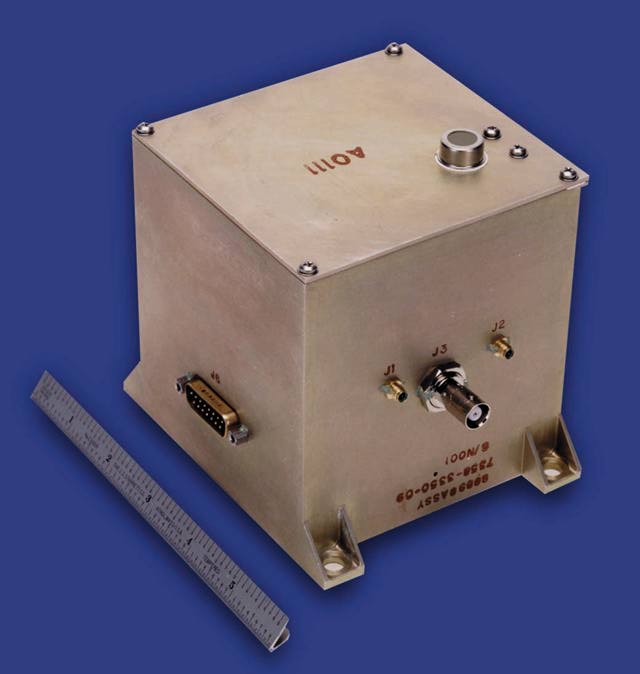
Solar monitor
XGRS Objectives
A primary goal of the NEAR mission is to measure Eros' surface composition accurately enough to establish the relationship between asteroids and meteorites. Although meteorites are thought to originate in the asteroid belt, the main type of meteorite (the ordinary chondrite) does not have a clear analogue among the recognized classes of Main Belt asteroids.The XGRS detectors have been sized to differentiate among important meteorite types. For example, the ordinary chondrite type H, the carbonaceous chondrite CI, the basaltic achondrite eucrite, and the stony-iron pallasite can all be distinguished from each other.
XGRS will either identify the type of meteorite to which Eros is linked or confirm that there is no relationship. The average composition of the asteroid will be determined to establish important constraints on origin, history, and processing of asteroidal material. Abundance maps of Mg, Al, Si, and Ca will be produced to determine heterogeneities in the surface (regolith). To the extent that X-rays and gamma rays can be compared for the same element, important insights into regolith variation with depth can also be gained: X-rays are emitted from the surface (less than a millimeter) while gamma rays tend to probe deeper material, up to about 10 cm in depth.
XGRS Description
The X-ray fluorescence experiment uses three gas-filled proportional counters, collimated to 5¡, observing X-ray line emissions from the asteroid. Balanced filters on two detectors (Al on one and Mg on the other) are used to separate Mg, Al, and Si lines; Ca, Ti, and Fe lines are resolved. The solar monitor uses an additional gas-filled proportional counter with a pinhole active area observing the X-ray spectrum of the Sun. A high-resolution, solid-state solar monitor can be alternatively selected. The gas-filled proportional counters were designed and built by Metorex International Oy. The solid-state X-ray detector was supplied by AMPTEK.The gamma-ray spectrometer uses a body-mounted NaI scintillator with BGO shield. This unique design eliminates the need for both a long boom and active cooling. This subsystem of the XGRS detects naturally radioactive elements-K, Th, U-by their gamma rays and those of their decay chain products. In addition, it detects other elements-Fe, Si, O, H-by gamma rays produced by cosmic ray interactions. The gamma rays of interest are typically between 0.2 and 10 MeV. The detector crystal/photomultiplier tube assembly was designed and built by EMR Photoelectric, a division of Schlumberger.
XGRS Management
- Science Team:
- Jacob I. Trombka (NASA/GSFC), Leader
William V. Boynton (Univ. of Ariz.)
Johannes Brückner (Max-Planck Institut-Mainz)
Steven W. Squyres (Cornell Univ.) - Lead Engineer:
- Lawrence J. Zanetti (JHU/APL)
- Lead Engineer:
- John O. Goldsten (JHU/APL)
- XGRS Instrument Scientist:
- Ralph L. McNutt, Jr. (JHU/APL)
- NEAR Payload Manager:
- Robert E. Gold (JHU/APL)
Links to the other NEAR instruments:
Return to Top of this page
Go to NEAR Overview Page
Go to Small Bodies Page