
Mission Summary
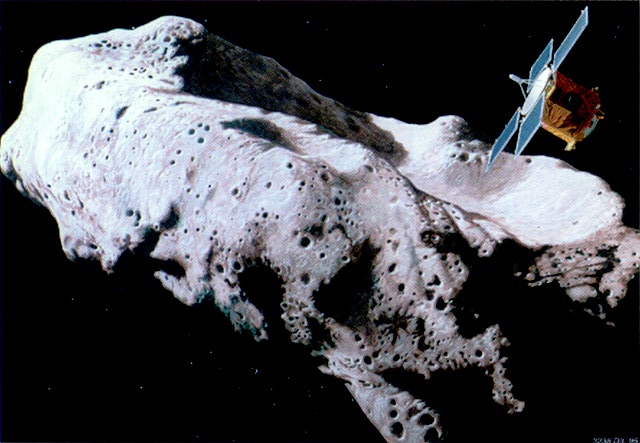
As the first spacecraft to orbit an asteroid, the NEAR mission promises to answer fundamental questions about the nature and origin of near-Earth objects, such as the numerous asteroids and comets in the vicinity of Earth's orbit.
These objects are of interest for several reasons. First, they are the primary source of large bodies that collide with Earth, greatly influencing the evolution of the atmosphere and life on Earth. An asteroid collision with Earth was likely responsible for the mass extinction at the end of the Cretaceous period, and another impact in 1908 destroyed thousands of square kilometers of forest near Tunguska, Siberia.
In addition, clues to the nature of early solar system processes and conditions are preserved in various forms on small bodies like asteroids, comets, and meteorites (so-called primitive bodies). These records have been altered or destroyed on large, planet-sized bodies by processes of planetary evolution.
The near-Earth population of asteroids, in particular, is believed to contain clues to the nature of the building blocks (planetesimals) from which the inner planets, including Earth, were formed.
The NEAR mission will provide our first comprehensive scientific survey of an important class of objects found close to Earth, the near-Earth asteroids, and promises to be an auspicious beginning for the NASA Discovery Program.
433 Eros
Approximate Dimensions: 	14 x 14 x 40 km
Rotation Period:		5.27 hr
Class: 				S (silicate rock)
Surface Regolith Present
Orbit Parameters:
  		Perihelion	1.13 AU
 		Aphelion	1.78 AU
  		Inclination	10.8 degrees
Mission Characteristics
Launch Period:		Feb 16-Mar 1 1996 (15-day window)
Launch Vehicle:		Delta II-7925-8
Trajectory:		2-year Delta VEGA
Primary Mission:	Rendezvous with 433 Eros in Jan 1999
End of Nominal Mission:	December 1999
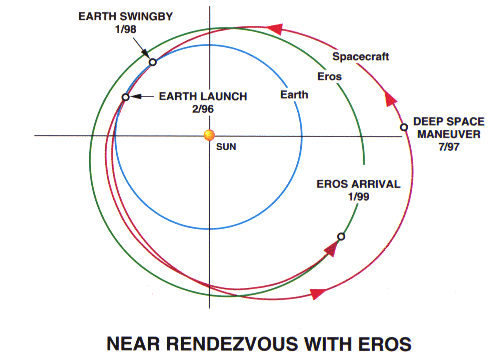
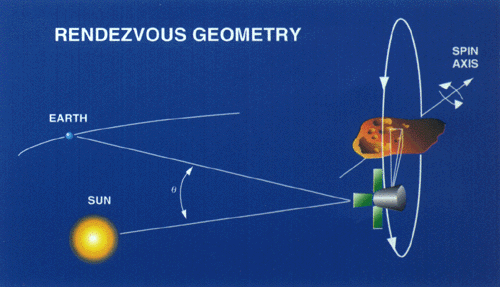
Rendezvous Geometry
Mission Objectives
- Bulk properties: Size, shape, volume, mass, gravity field, and spin state
- Surface properties: Elemental and mineral composition, geology, morphology, and texture
- Internal properties: Mass distribution and magnetic field.
Science Payload
Instrument			   Mass (kg)	   Power (W)
 Multispectral Imager System 		10		 7
 X-ray/Gamma-Ray Spectrometer		26		31
 Near-IR Spectrograph			18		 9
 Magnetometer				 1		 1
 Laser Rangefinder			 5		22
 Radio Science				 *		 *
Totals					60		70

*Part of engineering subsystems
Spacecraft Characteristics
Mass:			805 kg (includes propellant)
Basic Design:		Three-axis stabilized
			Fixed solar panels
			Fixed 1.5-m high-gain antenna
			Fixed instruments
			Passive thermal design
			Redundant critical subsystems
Power:			Solar powered 1600 W @ 1 AU
Telemetry:		X-band link to NASA Deep Space Network
Size:			1.7 square-meters at the base
Data Rate:		Selectable between 1 to 27 kb/s
Memory Capacity:	1.0-Gb solid-state
Propulsion:		(1) 100-lb thruster, (4) 5-lb thrusters,
			(7) 1-lb thrusters;
			total Delta V of 1420 m/s
Mission Control Center:	Applied Physics Laboratory
Navigation Support:	Jet Propulsion Laboratory
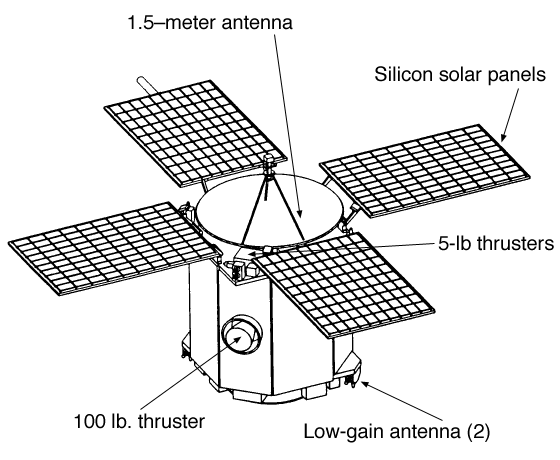
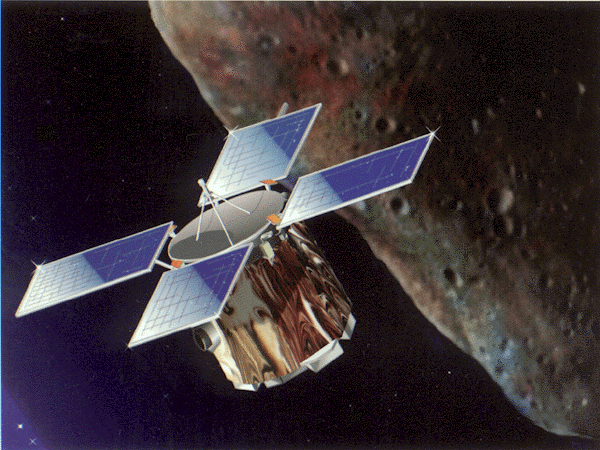
The NEAR Spacecraft
Mission Management
NASA Program Manager:	Elizabeth Beyer
NASA Program Scientist:	Jurgen Rahe
APL Project Manager:	Thomas Coughlin
APL Project Scientist:	Andrew Cheng
APL Mission Manager:	Robert Farquhar
Science Team Leaders
- Multispectral Imager / Near-Infrared Spectrograph
- Joseph Veverka Cornell University
- X-Ray/Gamma-Ray Spectrometer
- Jacob I. Trombka NASA/GSFC
- Magnetometer
- Mario H. Acuña NASA/GSFC
- Laser Rangefinder
- Maria T. Zuber JHU and GSFC
- Radio Science
- Donald K. Yeomans NASA/JPL
Return to Top of this page
Go to NEAR Overview Page
Go to Small Bodies Page