
Specifications
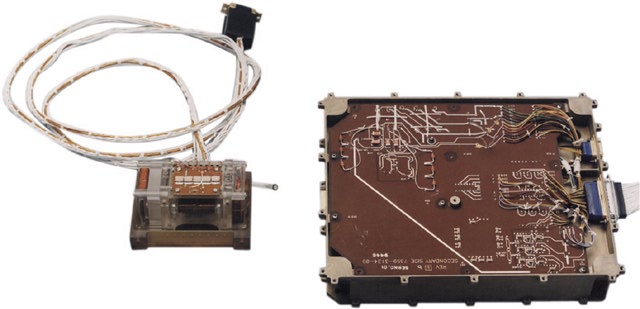
- Three-axis fluxgate sensor, antenna feed mount
- Electronics: analog sensor circuitry, ranging, A/D, filters, logic and gate array, DC/DC
- Output sample rate: 80 bits (commandable rate = 0.01-20 Hz)
Nominal rate 1/s: (DC) 0.0-1/s, digital filter
Bandpassed (AC): 1.0-10.0 Hz, rms amplitude - Eight Ranges:Full Scale: 4-65, 536 nT
Resolution: 16 bits, (AC: 8 bits log) - Software: range selection
Digital filtering: anti-aliasing, bandpass
Noise rejection
Command, control, telemetry formatting - Internal sample rate: 20/s, 20 bits
- Resources: 1.5 kg, 1.5 W, 80 bps
Instruments:
Fluxgate Sensor & Electronics
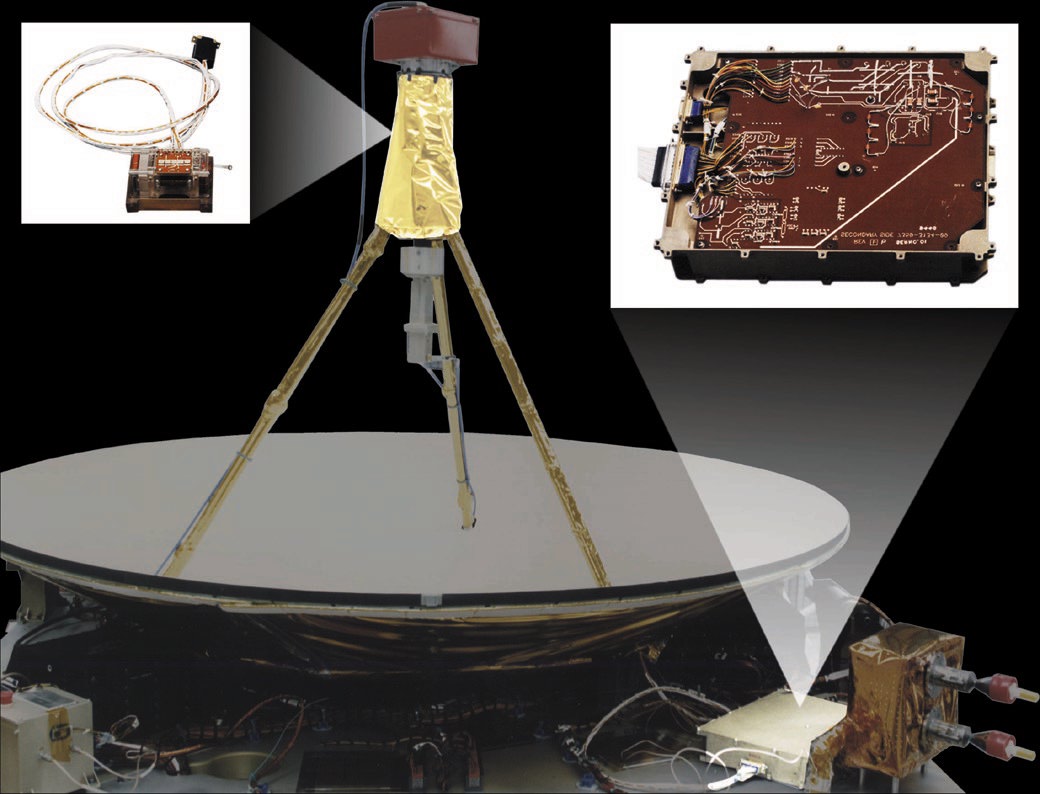
Antenna
Dish Assembly
Magnetometer Objectives
Eros is an S-asteroid, representative of the important class which dominates the inner asteroid belt. Scientists remain uncertain whether S- asteroids are undifferentiated bodies related to ordinary chondrite meteorites, or whether they are geochemically processed bodies akin to stony-irons. The issue is an important test of our understanding of the connection between asteroids and meteorites. If S-asteroids are unrelated to ordinary chondrites, then where do these most common of all meteorites come from? If the two are related, then why don't they look spectrally identical?The NEAR magnetometer may also help determine whether small asteroids are solid fragments of rock with densities like those of meteorite samples, or whether they tend to be porous piles of collisionally fragmented rubble with considerable void space. Many meteorites show measurable magnetization, but if Eros were a randomly re-accreted pile of fragments, one would not expect a significant coherent bodywide magnetic field.
Magnetometer Description
To minimize costs and spacecraft impacts, no booms are used. The sensor is mounted approximately 1 meter from the main spacecraft bus, on the high gain antenna feed support.The heritage of this magnetometer includes APL and NASA/GSFC instruments aboard Voyager, UARS, Geotail, WIND, Freja, Viking, Pioneer, POGS, Giotto, AMPTE/CCE, Mars Observer, and DMSP. The NEAR magnetometer sensor mounting configuration is similar to that used on the successful Giotto mission to Comet Halley.
Incorporated in the design is a complete calibration of the magnetometer as well as the effect on the instrument of spacecraft magnetic interference. Using proven methods and the statistics of nearly a year in orbit, even magnetic signals due to Eros that are smaller than spacecraft noise can be reliably isolated.
If Eros exhibits small natural remnant magnetization (NRM), the magnetic sphere of influence will be smaller than the 35-km NEAR rendezvous orbit, and the strength of the moment must be assessed indirectly by studying the magnetic perturbations associated with the Eros bow shock.
For intermediate NRM, the spacecraft may intermittently cross the Eros magnetopause, and magnetic fluctuation measurements will be used to assess these events.
For large NRM, the spacecraft will remain entirely within the Eros magnetosphere for extended periods of time.
Magnetometer Management
- Magnetometer Science Team:
-
Mario H. Acuña (NASA/GSFC), Leader
Christopher Russell, UCLA - Magnetometer Instrument Scientist:
- Lawrence J. Zanetti (JHU/APL)
- Lead Engineer:
- David A. Lohr (JHU/APL)
- NEAR Payload Manager:
- Robert E. Gold (JHU/APL)
Links to the other NEAR instruments:
Return to Top of this page
Go to NEAR Overview Page
Go to Small Bodies Page