
Captioned Image Release No. MSSS-610 — 14 February 2023
NASA/JPL-Caltech/Malin Space Science Systems
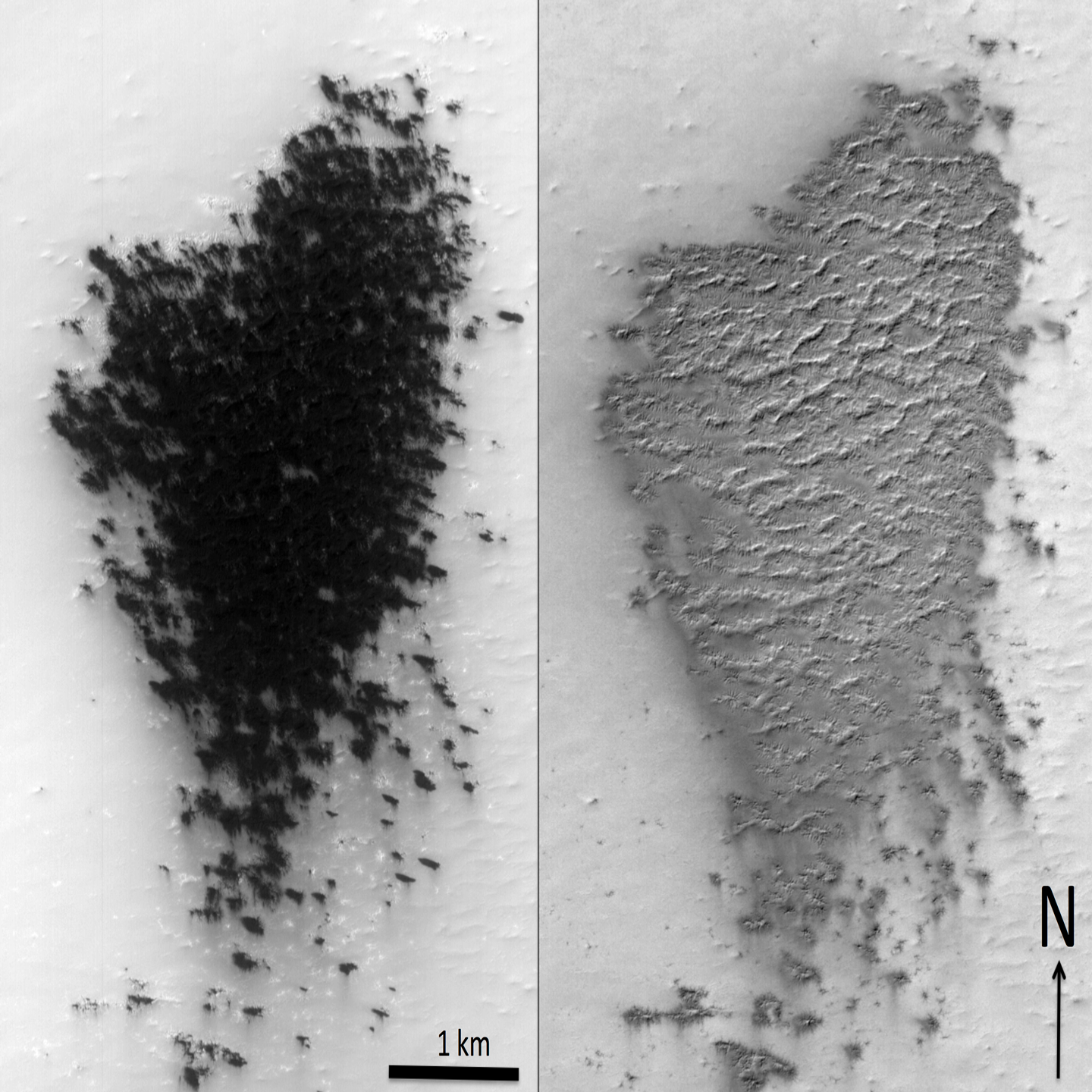
Left) CTX subframe of the full CTX image U10_074679_0985_XN_81S318W Right) Subframe of the full CTX image U12_075668_0985_XI_81S318W.
Mars Valentine 2023
Happy St. Valentine’s Day from the Mars Reconnaissance Orbiter (MRO) Context Camera (CTX)! We are celebrating this Valentine’s Day with a CTX image from Australe Lingula in the southern hemisphere of Mars.
These images, from the south polar region, show a ~3.5 km wide, heart-shaped field of araneiforms, or spider-like, radial depressions proposed to be formed through the seasonal CO2 ice sublimation process. The two CTX images show the feature as it appears in both southern spring (left), covered in CO2 frost, and in southern summer (right) once the frost has sublimated away. These images were taken by CTX on July 2nd, 2022 (Ls = 258) and September 17th, 2022 (Ls = 306), and both images have been contrast balanced for the full range of brightness. This feature is located at approximately 81.6°S, 318.6°W.
Over the past 24 years, Malin Space Science Systems has featured other heart-shaped martian landforms on Valentine's Day in images acquired by MRO CTX and the Mars Global Surveyor (MGS) Mars Orbiter Camera (MOC). These previous examples can be viewed by clicking on the following links:
- Mars Valentine 2022—14 February 2022
- Mars Valentine 2021—14 February 2021
- Mars Valentine 2020—14 February 2020
- Mars Valentine 2019—14 February 2019
- Jovian and Martian Valentine 2018—14 February 2018
- Mars Valentine 2017—14 February 2017
- Mars Valentine 2016—14 February 2016
- Love from Mars—14 February 2012
- Mars is Where the Heart is—14 February 2011
- A Martian Valentine for 2009—13 February 2009
- Happy Valentine's Day from MRO CTX—14 February 2008
- Valentine 2006—14 February 2006
- Martian Valentine's Day—14 February 2005
- Happy Valentine's Day 2004—14 February 2004
- Happy Valentine's Day From Mars!—11 February 2000
- From Mars, With Love—17 June 1999
To cite the image(s) and caption information in a paper or report:
Malin, M. C., D. A. Susko, C. Keegan, A. B. Valeh, G. T. Speth, and L. Posiolova (2023), Mars Valentine 2023, Malin Space Science Systems Captioned Image Release, MSSS-610, http://www.msss.com/science-images/mars-valentine-2023.php.
The image(s) and caption are value-added products. MSSS personnel processed the images and wrote the caption information. While the images are in the Public Domain, NASA/JPL-Caltech/MSSS requests that you credit the source of the image(s). Please give the proper credit for use of the image(s) and/or caption.
Malin Space Science Systems (MSSS) built and operates the Mars Science Laboratory (MSL) Curiosity rover Mast Camera (Mastcam) and Mars Hand Lens Imager (MAHLI) and Mars Descent Imager (MARDI), the Mars Reconnaissance Orbiter (MRO) Mars Color Imager (MARCI) and Context Camera (CTX), and the Jupiter Orbiter (JUNO) camera (Junocam). MSSS also built and operated the Mars Global Surveyor (MGS) Mars Orbiter Camera (MOC). In addition, MSSS built the Mars Odyssey (ODY) Thermal Emission Imaging Spectrometer (THEMIS) Visible (VIS) camera subsystem, which shares optics with the thermal infrared instrument and is operated at Arizona State University (ASU). MSSS also built the Mars Descent Imager (MARDI) for the Phoenix Mars Scout lander, the suite of high resolution cameras aboard the 2009 Lunar Reconnaissance Orbiter (LRO), and Origins-Spectral Interpretation-Resource Identification-Security-Regolith Explorer (OSIRIS-REX) mission. MSSS has also built and operated cameras for the Mars 2020 rover mission.