
Captioned Image Release No. MSSS-518 — 14 February 2018
NASA/JPL-Caltech/SwRI/Malin Space Science Systems
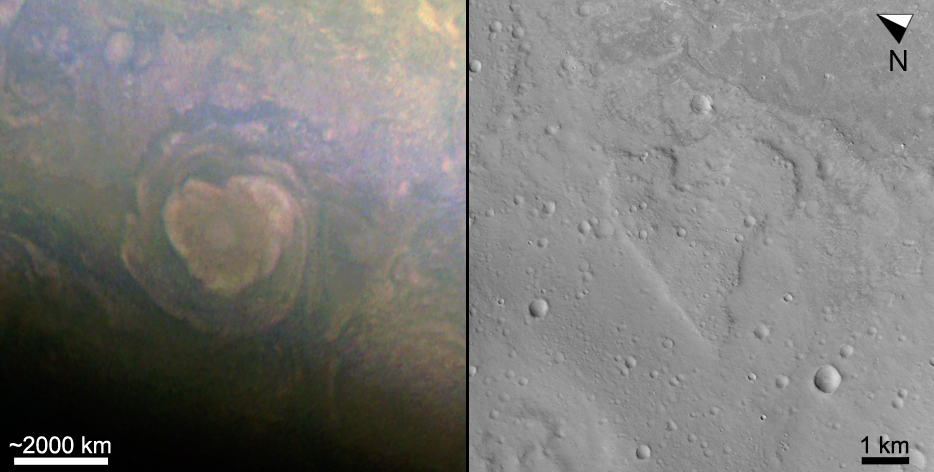
(Left) Subframe of the full JunoCam image JNCE_2017244_08C00107_V01. (Right) Subframe of the full CTX image K02_05116_2021_XI_22N271W. North is to the upper left and illumination is from the bottom left.
Jovian and Martian Valentine 2018
Happy St. Valentine’s Day from the Juno JunoCam and Mars Reconnaissance Orbiter (MRO) Context Camera (CTX) teams! This Valentine’s Day we are celebrating with two images, one from Jupiter (left) and one from Mars (right)!
The image on the left is a scaled and color enhanced image of a heart-shaped cloud feature in Jupiter’s atmosphere taken by JunoCam on the Juno spacecraft on September 1, 2017. At the time of acquisition, this feature was located at approximately 79.16°N latitude with an altitude of 41726.5 km near Jupiter’s terminator. The feature is approximately 2,500 km wide.
The picture on the right is of an approximately 4 km wide mesa landform on Mars taken by CTX on the MRO spacecraft on February 11, 2018. This feature is located at 23.75°N, 89.09°W in northern Isidis Planitia.
Over the past 19 years, Malin Space Science Systems has featured other heart-shaped martian landforms on Valentine's Day in images acquired by MRO CTX and the Mars Global Surveyor (MGS) Mars Orbiter Camera (MOC). These previous examples can be viewed by clicking on the following links:
- Mars Valentine 2017—14 February 2017
- Mars Valentine 2016—14 February 2016
- Love from Mars—14 February 2012
- Mars is Where the Heart is—14 February 2011
- A Martian Valentine for 2009—13 February 2009
- Happy Valentine's Day from MRO CTX—14 February 2008
- Valentine 2006—14 February 2006
- Martian Valentine's Day—14 February 2005
- Happy Valentine's Day 2004—14 February 2004
- Happy Valentine's Day From Mars!—11 February 2000
- From Mars, With Love—17 June 1999
To cite the image(s) and caption information in a paper or report:
JunoCam image:
Hansen, C. J., E. Jensen, L. Lipkaman, D. Krysak, R. Zimdar, and J. Sandoval (2018), Jovian and Martian Valentine 2018, Malin Space Science Systems Captioned Image Release, MSSS-518, http://www.msss.com/science-images/2018_02_14.php.
CTX image:
Malin, M. C., M. R. Wu, A. W. Britton, T. C. Brothers, and L. Posiolova (2018), Jovian and Martian Valentine 2018, Malin Space Science Systems Captioned Image Release, MSSS-518, http://www.msss.com/science-images/2018_02_14.php.
The image(s) and caption are value-added products. MSSS personnel processed the images and wrote the caption information. While the images are in the Public Domain, NASA/JPL-Caltech/SwRI/MSSS requests that you credit the source of the image(s). Please give the proper credit for use of the image(s) and/or caption.
Malin Space Science Systems (MSSS) built and operates the Mars Science Laboratory (MSL) Curiosity rover Mast Camera (Mastcam) and Mars Hand Lens Imager (MAHLI) and Mars Descent Imager (MARDI), the Mars Reconnaissance Orbiter (MRO) Mars Color Imager (MARCI) and Context Camera (CTX), and the Jupiter Orbiter (JUNO) camera (Junocam). MSSS also built and operated the Mars Global Surveyor (MGS) Mars Orbiter Camera (MOC). In addition, MSSS built the Mars Odyssey (ODY) Thermal Emission Imaging Spectrometer (THEMIS) Visible (VIS) camera subsystem, which shares optics with the thermal infrared instrument and is operated at Arizona State University (ASU). MSSS also built the Mars Descent Imager (MARDI) for the Phoenix Mars Scout lander and the suite of high resolution cameras aboard the 2009 Lunar Reconnaissance Orbiter (LRO). MSSS is currently working on cameras for the 2016 Origins-Spectral Interpretation-Resource Identification-Security-Regolith Explorer (OSIRIS-REX) mission and the 2020 Mars Science Laboratory (MSL) rover mission.